To Power Condition, Or Not To Power Condition?

Haven’t done a bass technique post in a while. Some helpful advise on running power conditioners from the guys over at Talk Bass. Here is a comment from fourstringburn:
One thing you should know about power conditioners. There great for plugging your rack mount equipment but contrary to opinions, You shouldn’t plug an amplifier into them….
The main reason why you shouldn’t run amplifiers into power conditioners is simply because your amp will starve for operating power when running hard because the power conditioners job is to maintain steady clean voltage, but when your amp demands more amperage, the power conditioner prevents it.
If you check with Furmans website, you’ll see they have a product called “Power Factor”. This is a type of power conditioner just for amplifiers for this exact reason. This products store up to 45 amps of power which is far greater than a regular power conditioner, so amplifiers will have the extra juice they need to run on when driving hard. This could be the difference between your amp sounding good or great when driving it hard.
I contacted Bob at QSC’s tech support on this product, but just like regular power conditioners, he doesn’t recommend this product for amplifier use either. He claims the best thing for an amplifier drawing up to 20 amps is to plug it straight to the power source and anything in between acts as a buffer, I agree!
So I myself run an high powered bass rig and my amplifier is plugged in straight to the source, but my preamps and other rack gear ( compressor, tuner,) are plugged in to a Furman PL-plus series 2 power conditioner. I highly recommend power conditioners for your other rackmount gear. The rack lights come in handy and it keeps your rack looking neat with one power cord coming from your rack.
Bill Fitzmaurice, of Bill Fitzmaurice Loudspeaker Design, agrees:
The main reason is that they aren’t necessary and don’t offer any improvement over the ‘conditioning’ already built into all well made gear. The so-called ‘dirty power’ issues they supposedly address are highly over-hyped and are filtered out by the power supplies in your gear anyway. And they can restrict the current supply to your amp, resulting in degraded performance.
An engineer from amp manufacturer Genz Benz (their little Shuttle amps are freaking awesome) says this:
1. The industry has a very (VERY) loose definition of what a power conditioner or protector or whatever they choose to call their device actually is or exactly what it does.
2. Most are UL listed for 15 amp loads only, protected buy a 15 amp thermal breaker and switched by a 15 amp rated switch. Putting a big amp or two on these can destroy the switches because most (if not all) switches are not protected by arc supression capacitors and the contacts can weld shut.
3. Most of these devices are worthless protecting against any real lightening strike nearby. Aside from too much inductance in the ground path (lightning is a very high frequency, high voltage signal), there’s not enough energy dissipation in the shunt protectors to prevent them from being blown to bits.
4. The typical “protectors” being discussed here do not protect against any kind of low or high voltage condition, regardless of what’s “implied”.
5. The typical “protector” has very limited spike protection, and even less surge protection. The spike let-through voltage is typically equal to about 200-220 volts peak.
6. The noise filtering is pretty much worthless, and duplicates the filtering in many amps on the market today. Folks that think they make a difference on audio frequencies are probably hearing something different… most are effective at radio frequencies but there’s plenty of this already in quality amps.
7. All amps that meet the CE standards already should contain the necessary protection to allow them to survive 2.5kV voltage spikes (both power line and to chassis ground), resist RFI (conducted and radiated), and have been tested by an accredited lab. I know for a fact that all of our amps have passed the battery of required tests.
8. Voltage regulating conditioners (much more expensive and heavier) in general should not be used with larger power amps because under some heavy dynamic conditions, the voltage regulating devices can hunt and oscillate. Some self-destruct and may take the amp out in the process.
Used as glorified power strips, they can be handy and in general can’t hurt, but as a consumer it’s important to be educated anytime a device promises something that’s usually too good to be true and can’t really be proven. Especially when there is a significant profit incentive involved, impartiallity is almost impossible.
Having some electronics theory under my belt, I figured that they were a bit over-hyped. I do have one, but it was a cheapie. It’s as much for the convenience of having a single switch to turn the rack set-up on and off, as much as anything else. Another plus of course; it has dimmable lights in front. Cool!
BTW, here’s my rack, such as it is.
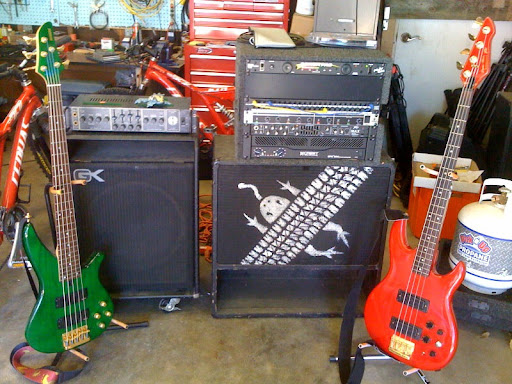
And yes, the propane tank is vital to my sound!!!!!
 Bass / Guitar Techniques | Sonicfrog June 4, 2010
RSS feed for comments on this post. TrackBack URI